


This is a summary version of an academic Global Violence of Women in Cults written by Doni Whitsett and Natasha Post Rosow, first published in the International Journal of Coercion, Abuse, and Manipulation, Vol. 1, No. 1, 2020. Read the full academic article on the ICSA Online Library, and the summary below.
At a glance
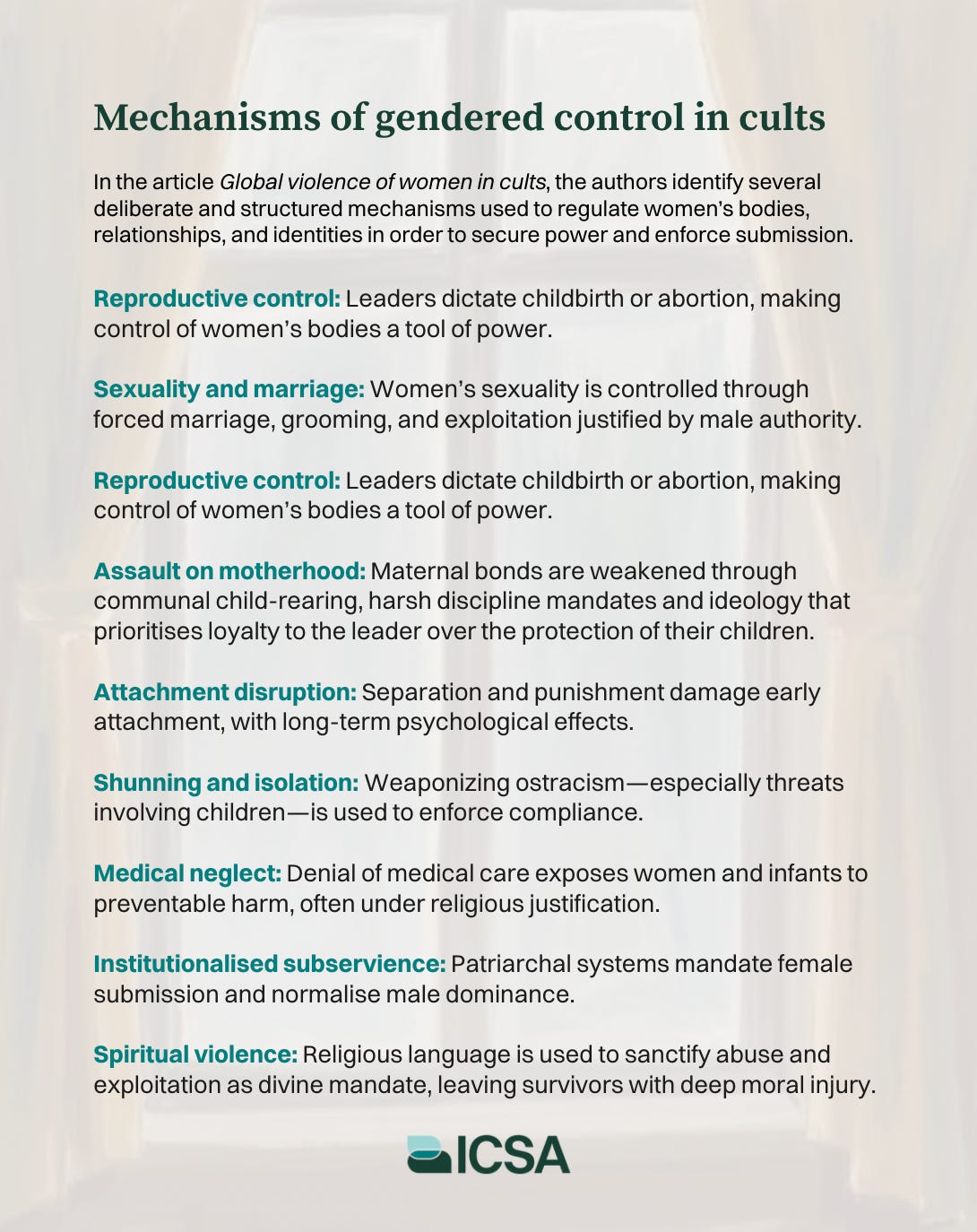
Whitsett and Rosow examine the pervasive violence against women and girls in “high demand groups” (HDGs) as a global, transnational issue that mirrors broader systemic gender inequalities. The authors detail the specific mechanics of control used to rob women of reproductive rights, bodily autonomy, and the right to protect their children. Through case studies and neuroscience, the article highlights the devastating impact of disrupted attachment and the unique struggle of “second-generation adults” raised within these isolated enclaves.
Who this article is for This research is critical for human rights advocates, transnational feminists, and social workers dealing with human trafficking and domestic violence. It also provides essential context for legal professionals and policy makers addressing the conflict between religious sovereignty and child safety.
Key points
The transnational nature of cultic violence Cultic abuse is not confined by borders; groups often move to different countries to avoid legal scrutiny or to spread grandiose ideologies. These groups function as isolated enclaves that operate apart from society, regardless of their physical location. The authors argue that the exploitation of women in cults is a transnational feminist issue, as the indoctrination and intimidation techniques used are strikingly similar to those found in sex trafficking, radical terrorist groups, and domestic violence.
“Gender-based inequality and unjust treatment of women and girls inside of cults mirror systemic inequality faced by women globally, and cults by their very nature involve isolating and marginalizing abuses of power…” (Page 74)
The plight of second-generation adults (SGAs) A growing cohort of survivors consists of children born or brought into cults at a very young age. Unlike first-generation recruits, SGAs have no “precult personality” or outside world experience to fall back on, making escape and reintegration exceptionally difficult. These individuals often exit the group with limited education, no family support, and a deep-seated indoctrination that the outside world is “sinful and evil,” leaving them feeling like strangers in their own culture.
“Sarah was a few months old when her parents joined the Twelve Tribes… She knew little of the world outside the Twelve Tribes communal farm where her family lived, prayed, and worked.” (Page 73)
The systematic assault on motherhood Cult leaders instinctively recognize that a strong mother-child bond competes with the leader’s demand for total allegiance. To neutralize this, cults employ methods to dilute attachment, such as overscheduling parents with work, physically separating families, or rotating caregivers in communal houses. Mothers are often forced to choose between being a “good” member of the group and protecting their children from harsh, sometimes life-threatening, “disciplinary” practices.
“Cult leaders instinctively know that it is difficult for a woman to be both a mother to her child and a compliant ‘child’ to the cult leader. Thus, leaders have various ways of preventing and diluting a strong mother-child attachment.” (Page 85)
Control of sexuality and reproductive rights Sexual and reproductive control is one of the most extreme forms of violence in cults. This ranges from forced polygamy and child marriage—where girls are socialized to “keep sweet” and accept nonconsensual encounters—to the other extreme of forced abortions or prohibited births. In many cases, female sexuality is purely a tool for the leader’s gratification or a recruitment tactic, reframed as a “spiritual practice” or “salvation”.
“Whether the leader forces women to have babies or prevents births from happening, control over women’s bodies remains in the hands of men.” (Page 84)
Neuroscience and the impact of disrupted attachment The authors utilize neuroscience to explain that a child’s brain develops through the nurturing relationship with their mother. When this attachment is disrupted by cultic neglect or abuse, the child’s brain may remain underdeveloped, leading to lifelong social-emotional and cognitive impairments. The constant state of fear and unpredictability in which cult mothers are kept further interferes with their ability to provide the “empathic maternal care” necessary for healthy brain development.
“Functional magnetic resonance imaging scans provide evidence that neglected children have smaller brains compared to those of children who grew up in loving homes.” (Page 85)
The conflict between religious sovereignty and human rights A major obstacle to protecting women and children in the United States is the sacrosanct view of religious freedom under the First Amendment. Many HDGs hide behind these protections to shield themselves from prosecution for child labor, human trafficking, or sexual abuse. The authors suggest that applying existing laws on human trafficking—which focus on the use of force or coercion to obtain labor—could provide a legal avenue for cult survivors to seek justice.
“Trafficking is often misconstrued as an act requiring transport when ‘the crux of the crime of human trafficking is not the transportation of a person, but the use of force to obtain labor or service of that person’.” (Page 89)
Conclusion Summary
Violence against women in cults is a pervasive violation of basic human rights that transcends religious doctrine and physical borders. By dismantling the mother-child bond, controlling reproduction, and grooming girls for subservience, these groups ensure a self-perpetuating cycle of dominance. Reclamation of the female voice is not only a personal recovery goal but a necessary step toward ending the systemic exploitation that hides behind the veil of religious sovereignty.
Why this is important
This article is significant for reframing cult dynamics as a global human rights issue rather than a niche religious phenomenon. It bridges the gap between cult studies and mainstream feminism, highlighting how “coercive persuasion” acts as a fundamental root for various forms of modern slavery and gender-based violence.
About the authors
Doni Whitsett, PhD, LCSW, is a Fulbright Scholar and Clinical Professor of Social Work at the USC Suzanne Dworak-Peck School of Social Work, where she has taught for more than 25 years. She has been working with cult survivors for three decades, publishes articles on this topic, conducts workshops to educate mental health professionals, and presents at conferences both nationally and internationally. Natasha Post Rosow, MSW, graduated from the USC Suzanne Dworak-Peck School of Social Work in 2017 after a successful 15-year career as a writer and screenwriter. She holds a BA from Harvard and an MFA from the University of Texas, Austin.


