

Jayanti Tamm’s guru, Sri Chinmoy, was born in 1931 and grew up in Bangladesh, which was part of India until 1947. He was orphaned at age twelve and moved into the Sri Aurobindo Ashram, where his siblings were already. He stayed there for twenty years. For a time, he felt disillusioned with life in this world, and jumped from a bridge to try to escape by suicide. However, when he hit the water, he said it felt like landing on a pillow. He survived with no injuries and believed the incident was a demonstration of his occult power. A similar experience took place on a train. He didn’t have a ticket, so when the conductor came down the aisle, he jumped out a window. The train was traveling at forty miles per hour, but he was spared again.
These experiences made him feel invincible. At the Aurobindo Ashram, Chinmoy revealed what he perceived as his divinity:
Dear friend, in my previous incarnations I had literally hundreds of occult experiences. In this incarnation I am no longer a baby who is fond of his toys. I have something most important to do for God in this incarnation. (Chinmoy, n.d.)
He said:
The spiritual Master comes into the world with a Mission. His Mission is to tell the world that he is of God’s illumination but always for man’s aspiration. (Chinmoy, 1974)
He declared that his mission was to serve people in the West, to help them find spiritual fulfillment. With the help of American sponsors connected with the Aurobindo Ashram, Chinmoy immigrated to the United States in 1964. He settled in New York, sharing stories of his occult experiences, and attracted followers who believed in him.
Chinmoy grew up playing soccer and volleyball, and he played tennis daily at the New York Center. He also participated in marathons, decathlons, and track-and-field events in the Masters Games. He took up weight-lifting in the mid-1980s and set several records in weight-lifting competitions. Because sports were important to him, he made it part of his mission. He wrote this to express his philosophical understanding of sports:
There is an inner life; there is spirit, and my ability to lift heavy weights proves that it can work in matter as well. I am doing these lifts with the physical body, but the power is coming from an inner source, from my prayer and meditation. (SriChinmoy.org, n.d.)
As a noted weightlifter, Chinmoy was driven to make his strength displays even more dramatic. One time, he supposedly lifted an elephant. Another time, he supposedly lifted 7,000 pounds with one arm.
“Her story, and all children who grew up in a cult, call on us to recognize the abuse inherent in a cult upbringing.”
As a representative of God, he believed he could bring about world peace. From 1970 to 1995, he was a volunteer for the United Nations as an Ambassador of Peace. His job was to lecture, give talks with Q&A, and lead meditations. Working with the UN brought him fame and respect around the world. He loved to meet celebrities and politicians, and they wanted to meet him. Famous musicians came to learn from Chinmoy, and take shelter under his wings. Chinmoy’s Centers held peace concerts, athletic contests, and other events for the public.
In the first pages of her memoir, Jayanti explains the circumstances surrounding her birth. Her parents barely knew each other, but one time the guru saw them together and decided they needed to get married. He had concocted a rule for some of his disciples to have a “divine marriage,” which meant they would be partners, but remain celibate. Her parents married, and after a short time, they were pregnant. Jayanti wrote:
Guru scolded my parents for being undivine…Eventually, Guru’s infinite compassion intervened. He pleaded with the “Supreme”…and told my parents that the Supreme was so moved by Guru’s prayers…then announced that he had contacted the “highest heaven” and arranged for a special soul to incarnate as his chosen disciple. (Tamm, 2009, p.7)
The chosen disciple was Jayanti. She grew up believing the guru was the representative of God, and thereby the most important person in the world. She was grateful the guru forgave her parents for what they did, and she willingly grew up as a bonded servant. Her job was to help Chinmoy with his mission and keep him happy. She embraced the job as her destiny and purpose in life. Only when she started school did she find out how unusual her life was. She decided to keep silent so she didn’t need to explain or defend it.
Jayanti saw no flaws in the guru when she was growing up, but she defines them in her memoir. First, he was old enough to be her grandfather, and an over-involved, judgmental grandfather, at that. He was verbally abusive and criticized her on a regular basis, even blaming her for his physical pain. As a child, she had blamed herself for invoking his anger. But it wasn’t her fault. She had no idea what she was up against. Cult leaders are known to use verbal abuse, constant criticism, and humiliation to control their followers. It’s no wonder Jayanti had a hard time trying to be the perfect disciple and fix the old man’s world for him.
Things seemed to be going okay for Jayanti. However, when she grew into a teenager, she got interested in boys and had a boyfriend. When the guru found out, he was infuriated and told her she must never have sex, never get married, and never have children. To force her to end the relationship, he sent her to his center in France. However, she felt lonely and worthless in Europe, and returned to the New York Center after one year.
The irritable old guru could manipulate Jayanti when she was a child, but as a teenager, she rebelled. She wanted to experience sex and love, and secretly continued to meet with boys. Feeling rebellious, one night Jayanti got dressed up and went out to a bar. She met a man who intrigued her, and pulled him into the restroom for a quickie sex encounter. Driving home in a violent thunder storm, she lost control of her car, and was sure she would die. She passed out. When she woke up, she was “stalled in the weedy brush well beyond the shoulder of the road.” (Tamm, 2009, p. 249)
Instead of thanking God she survived the car accident, she lectured herself as Chinmoy would. First, she shamed herself for having sex, then felt guilty because she disobeyed him. Next, she told herself the car accident was a punishment from God. It’s common for gurus to teach followers that God is watching them, and God will send horrific karmic punishments if a disciple disobeys or criticizes the guru. Finally, Jayanti’s inner voices told her she could not manage her own life, and her only alternative was to return to the group.
She wrote a letter to Chinmoy to ask if she could come back to the New York Center. He okayed it, and she went back. On one visit, she found Chinmoy displaying a large collection of child ride-on toy cars. He drove each car around the tennis court multiple times, while his disciples sat, watching with “folded hands in deep meditation, eager for the moment when Guru scooted past their area” (Tamm, 2009, p. 264). Jayanti felt embarrassed to witness this and said, “Guru’s self-indulgence, his ego sickened me” (p. 264).
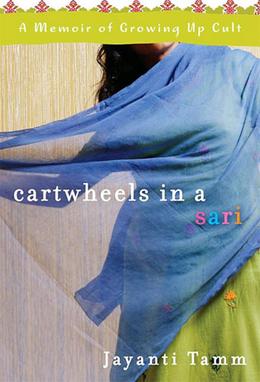
In the final chapter, titled “Cartwheels in a Sari,” Jayanti explains the story behind the book’s title:
One of the highlights of my entire year was performing gymnastics in Guru’s Madal Circus. Banned from wearing leotards because they were too revealing, in my circus costume of a shiny sari, fearlessly tumbling, somersaulting, and cartwheeling around the stage to Guru’s applause. He smiled and waved and told me to continue cartwheels in a sari as an encore. (Tamm, 2009, p. 265)
While she once had a connection to Chinmoy, after her return to the Center, he cut her off. She felt awkward going to the Center because Guru would not look at her or acknowledge her. The way she put it, “I was less valuable and viable for him to promenade, not as his model disciple, but as a disciple at all” (Tamm, 2009, 250). This was the only life Jayanti knew, and she felt torn over whether to leave. She talked it over with her best friend, including her guilt for the sexual encounter at the bar. She didn’t know at the time, but her friend betrayed her, reporting everything to Chinmoy.
“Jayanti went through a traumatizing experience, but she left and started to heal. Then she graciously shared her childhood memories in this book.”
Jayanti said she felt like she had already died and wanted to end her life. She considered jumping from a window, drinking poison, hanging herself, or slitting her wrists. She called a store to find out if she could buy a gun. Her final decision was to go to the subway and throw herself in front of a train. She tried, but a man in a janitor uniform pulled her back. She writes, “One week later, the phone rang. It was Ramesh [one of Chinmoy’s secretaries]. Without any explanation provided, Guru no longer wanted me to be his disciple. I was permanently banned from the Center” (Tamm, 2009, p. 274). She finally came to terms with what the rejection meant: “It was better to dispose of me now before I caused him further public disgrace” (Tamm, 2009, p. 278).
Chinmoy expected her parents to shun their daughter, but they were fed up too. They defended Jayanti for leaving and though they stayed in the organization seven more years, ultimately her parents divorced and left the group. Later, she found out her father “had been gathering evidence against” Chinmoy (Tamm, 2009, p. 285). He admitted that he knew the guru was a liar. He told Jayanti:
[A]t Sri Chinmoy’s house on the night of the 7,000-pound “miracle” one arm lift…the disciples present were instructed to meditate with their eyes closed and backs facing the barbell, my father disobeyed. He witnessed that Sri Chinmoy never lifted the weight. (Tamm, 2009, p. 285)
Jayanti Jayanti was born in 1970, the year Chinmoy joined the United Nations. His influence was going international, and he was busy opening centers in sixty countries. Hindu-based guru groups flourished in the seventies. I joined the Hare Krishna organization in 1978, believing it was more Hindu than cultic. The Hare Krishna zonal gurus repeatedly said the children born into the organization were demigods who came to Earth to spread Krishna’s mission. Several years after I left the temple, I learned of the brutal child abuse and neglect going on in many of the organization’s boarding schools. The perpetrators were mostly teachers and other personnel at the schools, but several zonal gurus were also abusing children.
Children are the most vulnerable people in a cult, and Jayanti’s story is an example of how cults damage children. Teaching children to believe they are chosen souls is dangerous and wrong. Due to the rampant child abuse in the Hare Krishna group, most of the children saw through the gurus’ rhetoric and rejected it. However, Jayanti grew up believing everything. Her story, and all children who grew up in a cult, call on us to recognize the abuse inherent in a cult upbringing. Jayanti went through a traumatizing experience, but she left and started to heal. Then she graciously shared her childhood memories in this book. Hers is a life no child should ever have to experience.


