

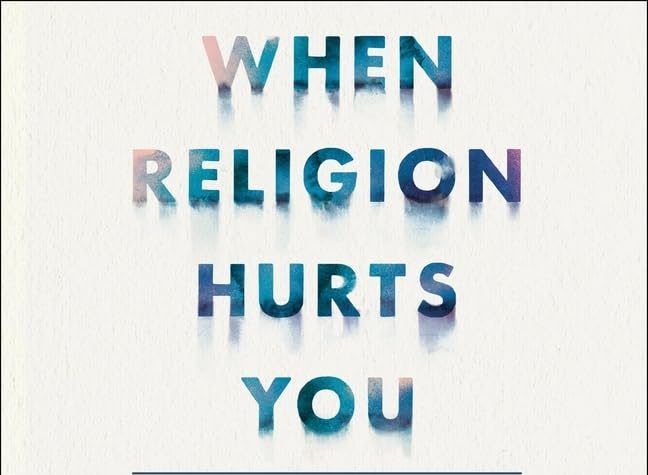
Laura Anderson begins When Religion Hurts You: Healing from Religious Trauma and the Impact of High-Control Religion by telling her personal story, which is one which I and millions of other people in this country can well relate to. As a child, religion was one of the things which fired her imagination. When she was only five years old, on the first day of kindergarten, she convinced her mother that she was ready to ask Jesus into her heart, and thus began her spiritual journey. Her family was religious—they were committed evangelical Christians—so church attendance, other church activities, and hearing the Bible read to her at home, were just a part of growing up. Later, as an adolescent, her family began to work at a church camp in rural Minnesota, which resulted in her being a bit in a bubble during the summers, and isolated from her school and regular church friends. Then, while she was still in middle school, the True Love Waits campaign swept the nation, and she talks a lot about how the purity movement caused her to feel alienated from her own body and to regard her own normal curiosity and budding sexuality as something sinful and disgusting. Nevertheless, Anderson continued in her religious commitment through high school, even though her extreme beliefs about sexuality caused her to develop a degree of religious scrupulosity.

After she graduated from high school, Anderson was unsure of what direction she wanted to take in life. Of course, this is not unusual for people at that time in their development, but her situation was complicated by the belief that God had a plan for her and if she made a wrong choice that meant she would be missing God’s will for her life. Although quite a few Evangelicals—and particularly those who lean more toward fundamentalism—believe something similar, there are other Christians, such as me, who think that God allows us to have free choice in matters which are not specifically matters of morality. Therefore, though God commands us to not commit murder or to steal, he does not really care what we choose to wear today, what we fix for dinner, or even which college we decide to attend—at least, that is my humble opinion.
Unfortunately, Anderson’s view that there was a perfect will of God for her life that she was in danger of missing made her vulnerable to the youth pastor from her church who approached her one Sunday after she graduated and told her that “God had revealed to him that (she) would be an excellent small group leader.” (p. 15) Though she was unsure, she thought she was hearing from a person who had some spiritual authority over her life, so she accepted. It turned out that she had some aptitude for the work and was able to advance over time to the position of assistant. However, it was in this position that she began to experience what she termed Adverse Religious Experiences (AREs). She found herself encountering a great deal of coercive control of a type that is completely familiar to those of us who study cults.
After a period of terrible abuse, Anderson quit working for the high-control religious institution—she later talks about High Control Religion (HCR)—and manages to find work at a secular community college, where she was surprised to see how much more respectfully she was treated than she was by the church she had worked for. Moreover, there did not seem to be any limitations on her just because she was a woman, the way there had been at the church job. Eventually, Anderson enrolled in a university where, though it was still strongly evangelical, she did not experience abuse, and she was able to obtain a master’s degree in counseling. Anderson allows herself to be vulnerable in telling her story, but she is using her own experience to set the table for what she wants to say about High-Control Religion (HCR), Adverse Religious Experiences (AREs), and the ways in which they can induce complex trauma in people who are subjected to them.
After telling her story in the first part of the book, Anderson moves on to a section which I thought was very good, in which she explains how AREs can lead to trauma in people and she does an excellent job summarizing how trauma affects the nervous system. She explains Post-Traumatic Stress Disorder (PTSD) and Complex Post-Traumatic Stress Disorder (CPTSD), and how religious trauma fits in the category of complex trauma. A minor quibble I have with the book is that Anderson drops in a couple of political statements, including at least one in this section, which felt out of place to me.
Anderson then moves to a section focused more on religious abuse, and she explains how controlling, authoritarian religion can be abusive. She discusses coercion and threats; intimidation; emotional abuse; isolation; minimizing, denying and blaming; patriarchal privilege; and economic abuse. Based on these, she creates her own version of the Duluth Model’s power and control wheel, which she helpfully includes in the appendix. Anderson further explains how systems built on power and control are abusive at their core. She goes on to discuss how these systems use the appearance of divine imprimatur to enable the leadership to arrogate more power and authority to themselves. Again, this is another strong section. Anderson writes well and explains things clearly. She articulates how groups use love-bombing in the recruitment phase, how the cultic relationship proceeds through what she terms as a tension building phase, and how this often leads to an explosion phase where such groups use public shaming to keep their members in submission. Interestingly, she says the explosion is often followed by a honeymoon phase, where the individual is restored to fellowship as things return to what feels like a safer status quo. Her description reminded me of how an abusive partner will often bring flowers and apologies in the wake of an incidence of intimate partner violence.
Parenthetically, I will comment that this seems to be a problem to which evangelical churches are especially susceptible. I think this is partly because leadership in many evangelical churches tends to be based on charisma, which is often indicative of underlying narcissism. As I write this review, a powerful evangelical leader in the area where I live, Robert Morris, has had to resign his position as senior pastor of a local megachurch due to a sexually abusive relationship he allegedly had with an underage girl, who was only 12 years old when the abuse started. In evangelical circles, this has been a big story. This is not to say that there are not millions of good people in evangelical churches in our country, but the evangelical church needs to grapple with these issues. I recommend that all evangelical Christians read Diane Langberg’s excellent book, Redeeming Power: Understanding Authority and Abuse in the Church, which I previously reviewed for ICSA Today.
Anyway, Anderson does an excellent job overall of describing how things can go wrong in the sort of churches which are like the one in which she grew up. She had to do a lot of therapy herself in her journey of healing from the abuse and the resultant trauma she experienced. She does a good job explaining why it is so hard for people to leave such environments—a challenge that was well described in Janja Lalich’s book, Bounded Choice: True Believers and Charismatic Cults. Certainly, fear that one might lose one’s salvation, or be left defenseless from attacks by the devil, causes many people to continue in their abusive churches. Even if things are bad where you are, it probably seems less bad than the risk of eternal conscious torment.
After more explanation of how trauma affects the nervous system and how abuse becomes embodied in those who are abused, Anderson then goes on to discuss rebuilding your identity after leaving HCR. She points out that healing is not about finding a fixed end point, but rather it is an “on-going and dynamic process” (p. 86). Just because one finds oneself triggered by something, that does not indicate a lack of progress, just that one still has more to learn, and that one can benefit from adopting an attitude of curiosity regarding why you have reacted as you just did. She discusses many of the things those of us who are mental health professionals do when we work with former cult members, such as helping to renew a sense of agency and the importance of maintaining healthy boundaries. She discusses how people need to redevelop personal autonomy, and how they need to heal from toxic messages about their sexuality. Anderson goes on to talk about restabilizing the nervous system and grieving the life you once had.
In summation, Laura Anderson has written a book which clearly explains how High-Control Religion can lead people to have Adverse Religious Experiences and end up with Complex PTSD, and I recommend it. However, I would like to add a bit of a trigger warning for people of faith who might want to read this book. Although Anderson is scrupulous to avoid any discussion of where she has landed in terms of her own faith in the wake of her abusive experiences, it is not hard to read between the lines. Though she is careful not to disparage other people’s religious choices, Anderson herself speaks as one who is in a post-Christian frame of mind. I take a moment at the end of this review to write a few words about this because it of the struggle that I see many people go through when they are separating from Totalistic Aberrant Christian Organizations (TACOs). They are not just looking for a path to shed the burden of religion so that they can settle into a secular humanist mindset—though that is the path that many of them eventually take. However, for many others, what they would like is to find a healthy way to continue to be a Christian, but with balance and maturity. People in that category are likely to struggle with this book, because they may feel upset that Anderson has landed more on the secular humanist side of that divide. That said, I do feel that there is enough of value in the book that it is worth reading for everyone.


